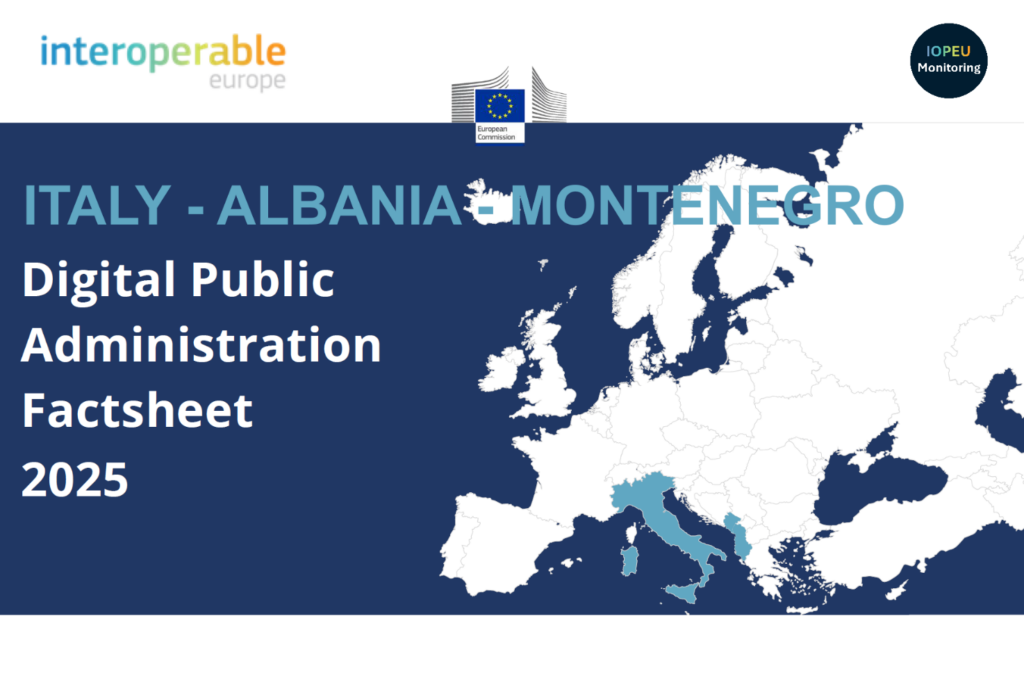

Comparative analysis of digital public administration: Italy, Albania and Montenegro
The Digital Public Administration Factsheets published within the Interoperable Europe monitoring framework provide a useful overview of how European and neighbouring countries are progressing in the digital transformation of public administration. A comparison between Italy, Albania and Montenegro highlights different stages of maturity in terms of digital services, interoperability frameworks and governance models.
Digital public services and maturity of eGovernment
Italy appears as the most advanced system among the three countries. According to the indicators derived from the Digital Economy and Society Index (DESI), Italy shows a high level of digital service availability. The country records a score of 83.6/100 for digital public services for citizens and 80.9/100 for services for businesses, while access to electronic health records reaches 84.1/100. These figures indicate a relatively mature ecosystem of online public services supported by a national electronic identification system.
Albania and Montenegro, instead, are not included in the DESI monitoring framework, which already signals a different level of integration within the EU digital policy monitoring mechanisms. Their factsheets therefore focus more on policy initiatives and strategic reforms rather than quantitative performance indicators.
Strategic frameworks for digital transformation
All three countries have adopted national strategies aimed at accelerating the digitalisation of public administration.
Italy’s strategy is strongly embedded in the Digital Italy 2026 plan, which is linked to the National Recovery and Resilience Plan and allocates more than €13 billion to digital transformation and connectivity. The strategy focuses on five main priorities: digital identity, digital skills, cloud infrastructure, interoperable services and high-speed connectivity.
Montenegro has adopted a Digital Transformation Strategy 2022–2026, combined with a Public Administration Reform Strategy covering the same period. These frameworks aim to modernise the public sector, strengthen digital competencies and improve interoperability across institutions, while also aligning the country with EU digital standards as part of the accession process.
Albania similarly places digital government at the centre of its administrative reforms, although the emphasis is often on building foundational infrastructure and regulatory frameworks rather than expanding already mature services.
Interoperability and data exchange
Interoperability represents a key dimension of digital government across all three countries, but the level of implementation differs.
Italy has established a comprehensive interoperability ecosystem based on the National Digital Data Platform (PDND) and API-based service integration among public administrations. The framework is also supported by the Once-Only principle, which allows public administrations to reuse data without repeatedly requesting it from citizens.
Montenegro has developed a National Interoperability Framework, first introduced in 2011 and updated several times, and a Single System for Electronic Data Exchange (JSERP) enabling data sharing between public institutions. In 2024 the system processed more than nine million queries, most of them related to population and tax registers.
Albania has also been developing interoperability mechanisms, but the focus remains on consolidating digital registries and enabling cross-institutional data exchange.
Governance and institutional capacity
Another important difference concerns governance and institutional capacity.
Italy relies on a well-established institutional ecosystem involving the Department for Digital Transformation and the Agency for Digital Italy (AgID), which coordinates national digital policies and provides guidelines for over 23,000 public administrations.
Montenegro has recently strengthened its governance structures through initiatives such as the Digital Academy and the Cyber Academy, which aim to enhance digital and cybersecurity skills among public officials.
In Albania and Montenegro, capacity-building programmes and digital skills development remain central elements of digital transformation policies, reflecting the need to strengthen institutional readiness alongside technological infrastructure.
Overall comparison
Overall, the comparison shows a clear gradient of digital maturity. Italy demonstrates a relatively advanced digital government ecosystem with measurable performance indicators and large-scale digital infrastructure investments. Montenegro and Albania are progressing rapidly but remain in a phase where institutional reforms, legal frameworks and digital infrastructure development play a central role.
Nevertheless, the three countries share common priorities aligned with the EU Digital Decade objectives, particularly in areas such as interoperability, digital identity, cybersecurity and the development of user-centred digital public services.
Notes
This comparative analysis was carried out by the Working Group of the GOVERNANCE project as part of its activities aimed at monitoring and analysing the digital transformation of public administrations in the European area. The analysis is based on the information published in the Digital Public Administration Factsheets 2025, available on the Interoperable Europe Portal (link below). These factsheets provide an overview of the main developments and initiatives related to digitalisation, interoperability and innovation in public administrations across European countries, offering a concise snapshot of national progress in the field of digital government.
The factsheets represent a key source of country-level intelligence on digital public administration and interoperability. They collect and synthesise information on national strategies, governance structures, technological infrastructures and policy initiatives related to the digital transformation of the public sector across Europe.
Building on these official sources, the GOVERNANCE Working Group conducted a comparative reading of the country profiles for Italy, Albania and Montenegro, with the aim of identifying similarities, differences and emerging trends in the digitalisation of public administrations and the development of interoperable digital public services.