

Strategic Ambition vs. Operational Reality: Insights from the Digital Maturity Assessment in Montenegro
As part of the Interreg Governance project, focused on empowerment and simplification processes for a digitally and well-governed South Adriatic, a Digital Maturity Assessment within the Instrument for Pre-Accession Assistance (IPA) institutional structure in Montenegro was completed.
Published in May 2026, this analysis report provides a crucial baseline for the Ministry of Finance and its connected structures, mapping out exactly where the system stands on its digital transformation journey.
DIGITS Survey Participants
To capture a truly systemic perspective, the survey targeted the core pillars of the IPA institutional ecosystem in Montenegro. Responses were aggregated from across the entire network, including:
- Directorate for Management of EU Pre-Accession Funds Structure
- Managing Authority
- Contracting Authority
- Project Implementing Units
Overall Digital Maturity: A Differentiated Profile
The aggregated results reveal a structurally imbalanced digital maturity profile. The fundamental takeaway is clear: Montenegro’s IPA structure is strategically mature but operationally constrained.
While the policy, funding, and governance foundations are robust, they are not yet supported by the technical tools and automated workflows necessary for full-scale digital optimization. The majority of analyzed themes fall squarely into the “medium maturity” category, signaling that the system is in a transitional phase.
- High Maturity in Governance and Digital Strategy, Sustainability and Social Impact
- Moderate in Information, Intangibles, Digital Infrastructure
- Low Maturity in Technology
Deep-Dive with DIGITS
The assessment evaluated six distinct dimensions, exposing a gap between strategic preparedness and technological execution.
Highs: Governance and Sustainability
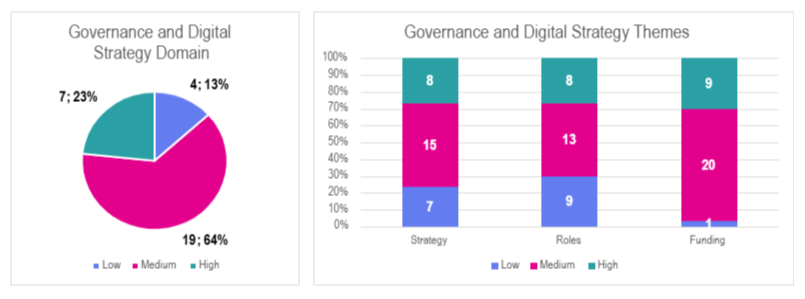
Governance and Digital Strategy is the strongest dimension: Institutions display high strategic awareness, defined roles, and excellent resource allocation, with Funding emerging as the single strongest thematic component.
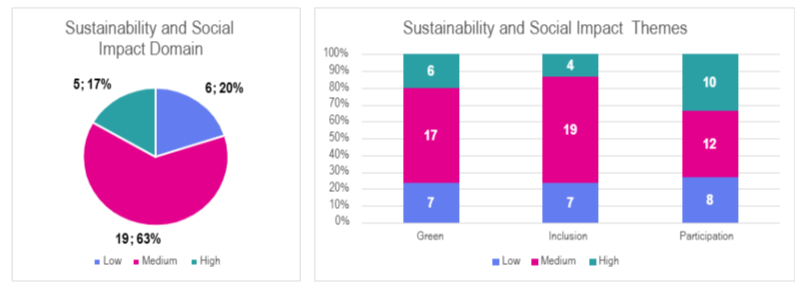
Sustainability show a strong performance driven heavily by Participation (stakeholder involvement). While principles like “Green” and “Inclusion” are recognized, they still rely too much on temporary project-based approaches rather than institutionalized habits.
Moderate Foundations: Infrastructure, Intangibles, and Information
Digital Infrastructure is unevenly developed. Technical baselines exist, but a lack of integration between platforms means the technical backbone is only partially ready.
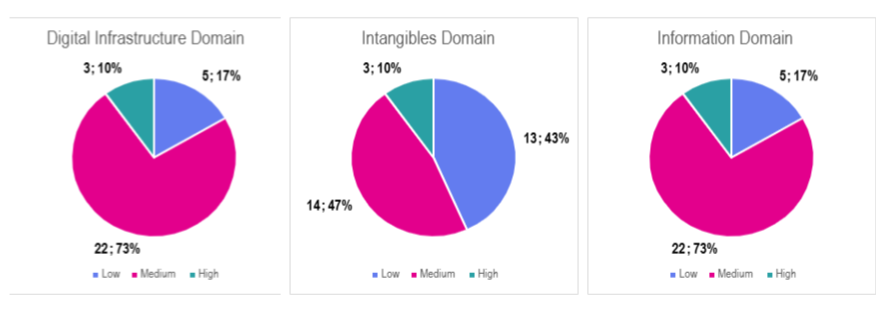
Human capital represents a mixed bag. While organizational Culture toward digitalization is highly positive, the lack of structured training programs and performance-tracking (Monitor) tools limits operational capacity.
Information handling and compliance with GDPR are highly developed. However, internal data systems lack full integration, meaning data is not yet systematically leveraged to support decision-making.
Weaknesses: Technology
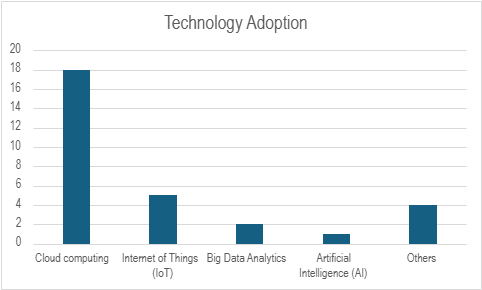
Adoption of New Technologies is the most critical systemic bottleneck. The low score reflects a heavy reliance on basic or legacy systems and a strong gap in advanced digital tools or automated, data-driven workflows.
Strategic Recommendations for PA Advancement
Interreg Governance roadmap prioritizes four actionable pillars:
- Prioritize the Tech Deficit: Shift investments toward cloud solutions, automation, and modern data-driven tools to replace legacy systems.
- Unify the Infrastructure: Standardize data exchange to ensure smooth interoperability across the departments.
- Institutionalize Human Capital: Move away from ad-hoc training and introduce continuous, structured digital skills programs and knowledge management platforms.
- Operationalize Governance: Align high-level strategies directly with the day-to-day realities of public administrators to reduce fragmentation.
Conclusion
The DIGITS survey proves that Montenegro’s Ministry of Finance structures have the vision, leadership, and funding willingness required for a digital future. However, the technological and human capacity deficits act as a brake on actual progress.
The Interreg Governance project will continue to support the Montenegrin IPA structure in translating its high-level strategic maturity into a modernized, seamless, and operationally excellent public administration.

